 Corner Booth Blog | TundraFMP Restaurant Supply, News & Equipment Blog
Are Test Strips Required, and Why?
Commercial sanitizers and test strips are required by health department regulations, and in Colorado those are the Colorado Retail Food Establishment Rules and Regulations. Why do you need 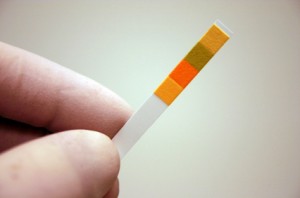 them? Because test strips tell you if the chemical sanitizing solution is the required concentration. Section 4-402 reads:
“A test kit or other device that accurately measures the concentration in parts per million (mg/L) of the sanitizing solution shall be available and used.”
What is Sanitization and Why is it Important?
Good questions, and I’m glad you asked! Here is the definition from Section 1-202:
“Sanitization means the application of cumulative heat or chemicals on cleaned food-contact surfaces that, when evaluated for efficacy, is sufficient to yield a reduction 5 logs, which is equal to a 99.999% reduction, of representative disease microorganisms of public health importance.”
Simply put, if you apply either sufficient heat, or sufficient chemical sanitizer, then nasty microbes that can make you sick are reduced by 99.999%. That protects you and your customers, and it is important. The regulations define how much is sufficient, and I discuss that next.
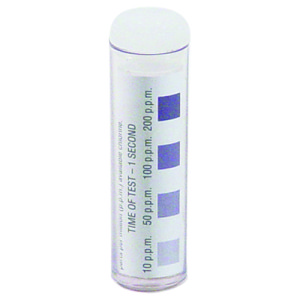
Types of Chemical Sanitizers
The three most common chemical sanitizers are chlorine-based, quaternary ammonia (QA), and iodine- based. The required concentration ranges are below:
- Chlorine-based (available chlorine as hypochlorite) | Between 50 ppm and 200 ppm
- Quaternary ammonia (QA) | Between 100 ppm and 400 ppm
- Iodine-based (available iodine) | Between 12.5 ppm and 25 ppm
How Do You Use Test Strips and How Often?
Chlorine-based sanitizers: Dip the strip into the sanitizing solution, then immediately remove and compare to the color chart. If it reads between 50 ppm and 200 ppm, then the concentration is fine.
Quaternary ammonia (QA) sanitizers: Dip the strip into the sanitizing solution for 10 seconds, then remove and compare to the color chart. If it reads between 100 ppm and 400 ppm, then the concentration is fine.
Iodine-based sanitizers: Dip the strip into the sanitizing solution for 60 seconds, then remove and compare to the color chart. If it reads between 12.5 ppm and 25 ppm, then the concentration is fine.
If the concentration is either too low or too high, either add sanitizer or dilute as needed in order to achieve the required concentration.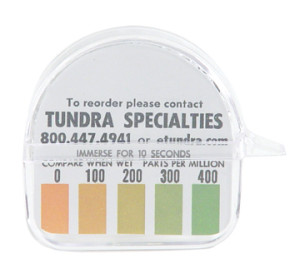
How often do you need to check the concentration? The Colorado regulation does not specify. But you need to check often enough to ensure the proper concentration at all times. A minimum of twice a day is my recommendation.
If you have a high temperature dish machine in Colorado, you must provide a minimum temperature of 160 F on the surface of utensils/equipment to ensure that sanitizing has actually occurred. Since dish machine gauges can be inaccurate, purchase and regularly use hot water test labels.
Fryer oil and pH test strips are not required by the Colorado regulations.
Remember This!
- Test chemical sanitizers in all locations. This includes the buckets for your wiping cloths, the 3-compartment sink, and the low temperature dish machine.
- Inspectors will often ask for your test strips and have you test the sanitizing solution, or they will test it themselves. Asking you to provide the strips will show them if you keep them readily available…a manager scrambling to find them is a bad sign! Secondly, watching you do the test will show them if you know how, so be prepared.
- The requirement for test strips is non-critical, and if you violate it, it is marked as an 11C violation on the inspection form. But have the strips, use them, make sure your staff knows how to use them, and keep all your sanitizing solutions at the proper concentration.





Great guide. Should low temperature dishwashers be tested to make sure that the temperature is high enough just like high temp dishwashers are? I think the regulation is 120 F or something like that.
Matt – since dish machines sanitize by either sufficient heat or by chemical means, you need to use the correct test strip. For a low temperature machine, use the appropriate chemical test strip. For a high temperature machine, use the temperature test strip (https://www.etundra.com/health-supplies-food-safety/food-safety-supplies/food-sanitizers-test-strips/commercial-single-temperature-dishwasher-test-labels/).
Jim.
Hello Jim
Do they make a Sanitizer test that is in gauge form
alot like a batterie tester.
Or do they have to see the result of the strip every time…
What’s the EXPIRY on these strips.. or is there any?
I don’t see anything written from the manufacturer.
Why is there an expiration on powder sanitizer and how critical is it if it is expired? They still test properly.
Hi Lisa,
The date stamped on the bottle is the manufacturer date. These don’t have an expiration date. As long as the cap is sealed and they are not exposed to moisture they should last forever.
Paul
– Tundra Team
Hi,
I would like to ask how do you measure chlorine residue after sanitizing machines and equipments? For example, I clean my machine with chlorine and let it dry, how will I measure the chlorine residue after the solution dried?
Thanks!
We have the red color sanitizer at the school i work at after we pump sanitizer in red bucket, what temp water is suppose to be added?
Thank you
HI Im trying to find a test strip for free chlorine and total chlorine that test in small increments but high range. Could you make any recommendations? My range is 10-150ppm.
Hi Jim,
Our test strip expired May 1,2019. Is it still good? We compared testing from New one and Expired it slightly changed in color. exactly 50 days. I’ll say it read 200ppm. What does the expiration date means? That we can no longer use it? How potent? The surveyor is giving us a hard time.
Thank you.
When do you need more than one sanitizer test strip